
Every golf apparel founder faces this critical sampling dilemma: Should your signature custom polo be built on classic technical piqué, ultra-smooth single jersey, or substantial interlock double-knit?
Choosing the wrong knit structure does not just alter the aesthetic handfeel—it directly causes sampling failures. A lightweight single jersey paired with an unreinforced self-fabric collar creates a curling, collapsed “bacon neck” after three washes. Conversely, a dense piqué knit paired with hyper-detailed digital printing results in broken graphic lines and fuzzy logo edges.
At Guangzhou Joyord Sportswear, we engineer high-performance golf apparel for tournament-grade brands and bespoke private labels. Here is our direct factory verdict:
- Choose Technical Micro-Piqué if your brand identity leans toward classic athletic heritage, demanding convective airflow, mechanical breathability, and rigid collar stability in high-humidity climates.
- Choose Performance Single Jersey if you want ultra-soft drape, next-to-skin mobility, four-way stretch recovery, and razor-sharp printed graphics.
- Choose Compact Interlock if your collection commands luxury retail pricing, total opacity (zero see-through in white/pastel colorways), zero edge curling, and a tailored, formal silhouette that holds its shape.
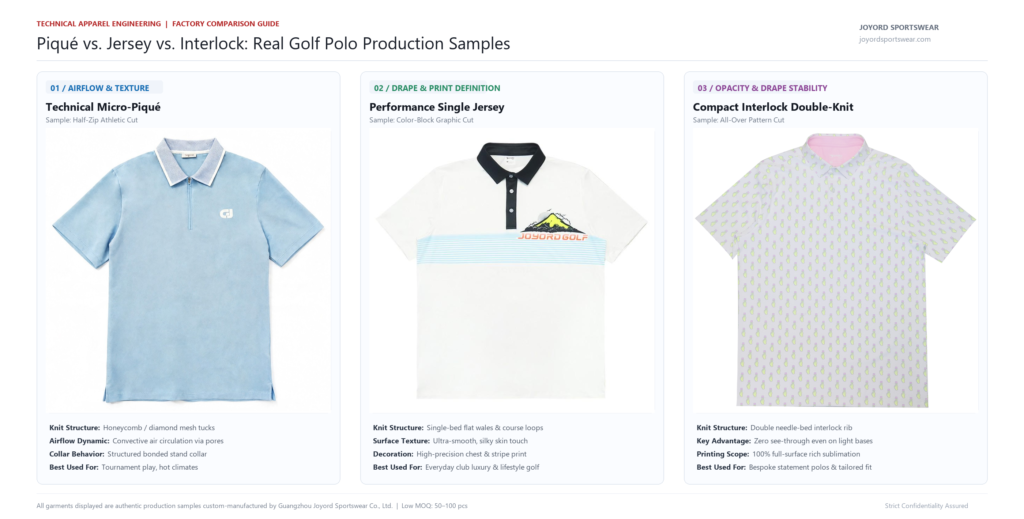
Quick Comparison: Piqué vs. Jersey vs. Interlock at a Glance
| Engineering Dimension | Technical Micro-Piqué | Performance Single Jersey | Compact Interlock Double-Knit |
|---|---|---|---|
| Knit Construction | Cellular mesh with geometric knit-and-tuck stitches | Single needle-bed flat wales (face) & course loops (back) | Double needle-bed interlocking 1×1 ribs |
| Surface Profile | Waffle, honeycomb, or diamond micro-texture | Flat, ultra-smooth, clean face | Mirror-smooth on both face and back |
| Airflow Dynamic | High convective ventilation (physical air openings) | High (in finer-gauge constructions; superior to interlock) | Low convective ventilation; high thermal insulation |
| Moisture Management | Physical aeration + capillary fiber wicking | Rapid capillary wicking + quick-dry dispersion | Controlled moisture absorption; slower dry-time |
| Structural Drape | Crisp, semi-rigid, structured stand | Fluid, clinging, high-motion drape | Substantial, tailored, elegant heavy drop |
| Opacity & Sheerness | Textured coverage prevents light pass-through | Requires 170+ GSM or darker dyes to prevent sheer | 100% opaque; eliminates see-through in white |
| Collar Integrity | Excellent support for bonded stand collars | Requires fusible interlining to prevent collar curl | Exceptional natural stability for structured collars |
| Printing Precision | Suited for bold screen prints & silicone badges | Ideal for high-definition sublimation & heat transfers | Excellent for deep-penetration all-over print |
| Typical Golf Weight | 170 – 210 GSM | 160 – 190 GSM | 180 – 230 GSM |
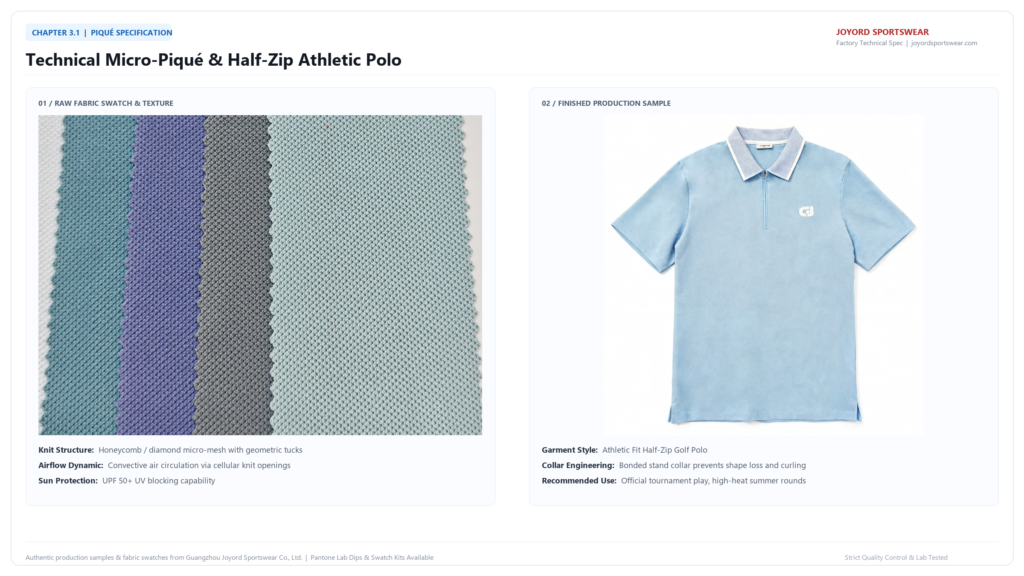
1. Technical Micro-Piqué: The Breathable Athletic Standard
Traditional golf polos relied heavily on heavy 100% combed cotton piqué. While historically prestigious, pure cotton piqué absorbs sweat, becomes waterlogged, and loses dimensional stability under tournament conditions.
Modern performance piqué utilizes a micro-cellular structure—typically knitted on 28-gauge or 32-gauge circular machines using a blend of 90–92% Recycled Polyester (or Performance Poly) + 8–10% Spandex.
How the Knit Works
The alternating knit-and-tuck stitches create microscopic geometric pockets (honeycomb or diamond patterns). These micro-openings serve two critical engineering functions:
- Convective Airflow: Unlike a flat fabric that relies purely on chemical wicking finishes, piqué physically vents heat away from the golfer’s torso during swing rotation.
- Reduced Skin Cling: Because only the raised ridges of the fabric touch the skin, the contact surface area is reduced by roughly 30%, preventing that sticky, clingy sensation during humid summer rounds.
Factory Engineering Note: When decorating micro-piqué, avoid hyper-detailed Direct-to-Garment (DTG) artwork with fine typography. The cellular surface breaks up micro-lines. For piqué, we strongly specify matte silicone heat-transfers, high-density 3D rubber badges, or clean embroidery with light backing.
2. Performance Single Jersey: The Silky, High-Stretch Favorite
Single jersey represents the modern transition of golf apparel into athletic athleisure. Knitted on a single needle-bed circular machine, all loops are pulled to the technical face, creating distinct vertical wales on the outside and horizontal course loops on the reverse.
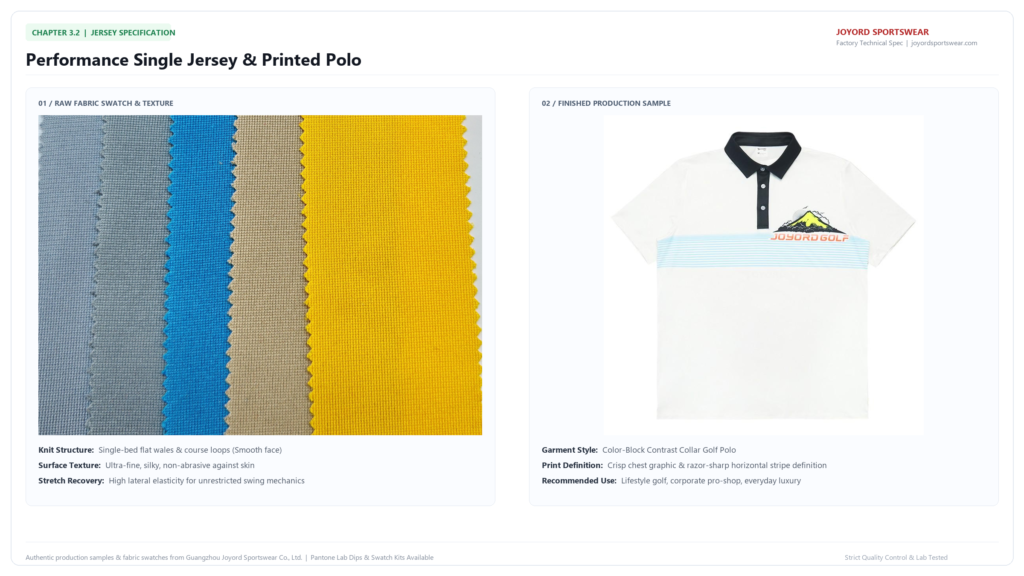
Why Tour Players Love It
Jersey provides an unrestricted range of motion. Because the yarn loops have room to deform in both warp and weft directions, a jersey polo moves completely friction-free across the upper back during the backswing. When blended with high-grade elastane (up to 12%), it delivers near-instant stretch recovery.
The Engineering Challenges (and Solutions)
- Sheerness Risk: In lightweight summer weights (under 160 GSM), white or pastel single jersey can become see-through. For white body panels, we recommend a minimum of 175–185 GSM or engineered yarn cross-sections.
- Edge Curling: Single jersey naturally releases knit tension by curling toward the technical face along the edges. In production, raw edges must be precisely controlled on automated spreading and cutting lines to prevent torque and twisted side seams.
Factory Engineering Note: Single jersey is the undisputed king of custom all-over sublimation and razor-sharp chest graphics. The smooth, flat surface allows sublimation inks to transfer with photorealistic edge definition. Explore our Custom Golf Polo Collection to see various jersey cut-and-sew executions.
3. Compact Interlock: The Non-Sheer Luxury Tailored Choice
If your brand targets high-end country club pro shops and corporate executive tournaments, Compact Interlock is your primary structural weapon.
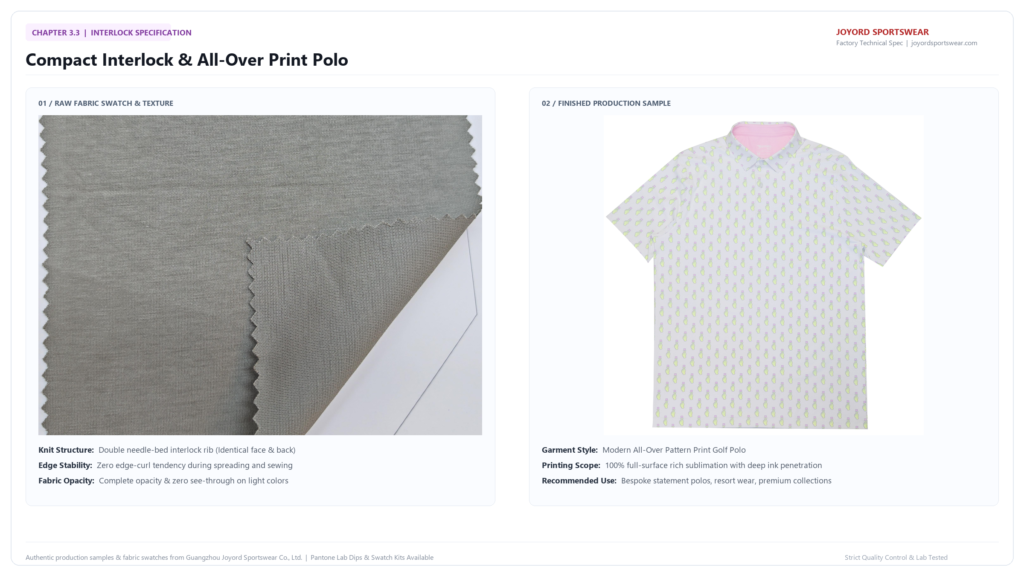
The Double-Knit Difference
Unlike jersey, interlock is knitted on a double needle-bed circular knitting machine where two 1×1 rib structures are interlocked back-to-back.
- Mirror Surface: The face and the reverse are completely identical. There are no exposed course loops.
- Zero Edge Curl: Because the internal stitch tensions balance each other out, interlock lies completely flat on the cutting table without rolling.
- Total Opacity: Because of the overlapping double-needle barriers, white and light pastel interlock polos have zero see-through issues, even when soaked in perspiration.
Weight & Drape
Interlock naturally carries more fabric weight (typically 190–230 GSM). It produces a clean, architectural drape that conceals body contours, offering a more tailored, formal fit than single jersey.
4. How Fabric Knit Dictates Collar and Hem Engineering
A common mistake emerging brands make is designing a garment solely on CAD screens without adjusting garment construction to the chosen fabric. The knit structure dictates how the collar, placket, and hem must be constructed.
1. The Two-Piece Stand Collar vs. Rib-Knit Collar
- On Piqué: Traditional 1×1 rib-knit jacquard collars match the sporty heritage of piqué. However, the yarn composition of the rib collar must match the shrink rate of the piqué body; otherwise, the collar puckers after washing.
- On Single Jersey & Interlock: Never attach an unreinforced self-fabric flat collar to a single jersey polo. It will curl and collapse. We engineer a Two-Piece Bonded Stand Collar—incorporating a structured collar stand (pedestal) and a woven fusible interlining inside the collar leaf. This guarantees a crisp, tailored roll that sits neatly under a blazer.
2. Side Split Vents & Stress Distribution
Golf swings exert extreme rotational torque on the bottom hem.
- On Jersey and Interlock, side split vents must be reinforced with 18–28 stitch computerized bar-tack stations or herringbone twill taping inside the vent.
- We engineer a subtle 1.5–2.0 cm drop-tail (longer back hem) to ensure the polo stays tucked in during full driver extension. Learn more about our 30+ home laundering cycle construction standards.
5. Three Critical Fabric Myths in Golf Polo Sourcing
Myth 1: “Higher GSM always means superior luxury.”
False. A 220 GSM standard cotton piqué feels heavy, traps heat, and sags when damp. In modern performance golf, a 175 GSM micro-denier poly-spandex jersey with moisture capillary channels commands a far higher retail price point than a heavy, cheap cotton knit. Match fabric weight to playing climate, not an arbitrary weight scale.
Myth 2: “Piqué breathes better than jersey in all conditions.”
Partially False. Piqué excels in convective ventilation (breeze passing through open mesh pores). However, in still, indoor environments or low-wind rounds, a fine-gauge single jersey with hydrophilic chemical finishes wicks perspiration away from the skin faster than piqué.
Myth 3: “Bamboo fabric requires no synthetic blend.”
False. Pure 100% bamboo rayon has low wet modulus—when saturated with sweat, it stretches and deforms irreversibly. For golf polos, bamboo rayon must be blended with performance polyester and 5–8% spandex to provide dimensional recovery and tensile strength.
6. Factory Inspection Protocols: How We Test Every Bulk Lot
At Joyord Sportswear, bulk fabric is not released to the cutting tables until it clears three independent quality control protocols:
- Dimensional Stability to Home Laundering (AATCC 135):
While general industry acceptance allows up to ±5.0% dimensional change, our internal bulk tolerance is held to a strict ±3.0% limit for premium golf programs after three consecutive domestic wash and dry cycles. We also maintain an internal torque and spirality threshold of<2.5%to prevent twisted plackets. - Color Fastness Under Perspiration and Rubbing (AATCC 15 & AATCC 8):
Tested against synthetic acidic and alkaline perspiration solutions. All colorways must maintain Grade 4.0 or above to prevent dye bleeding from dark contrast collars onto light-colored bodies. - Pilling Resistance (ISO 12945-2 / Martindale Method):
Golfers wear heavy stand bags with abrasive shoulder straps. Our performance piqués and jerseys achieve Martindale pilling grades of 4–5 after 2,000 cycles, along with high abrasion resistance. Read our complete guide on How to Choose a Golf Apparel Manufacturer.
Frequently Asked Questions (FAQ)
What is the most popular golf polo fabric for startups?
Performance Single Jersey (around 170–180 GSM, 88% Poly / 12% Spandex) is currently the best-selling fabric for emerging golf brands. It provides the modern athletic handfeel popularized by leading tour brands and accepts versatile decoration techniques.
Can we combine different fabrics in a single polo?
Yes. A popular engineering technique is “body mapping”: using a crisp, opaque compact interlock for the front chest panel and collar, combined with a breathable technical micro-piqué under the arms and across the upper back where ventilation is critical.
Which fabric holds sublimation colors the longest?
Both single jersey and interlock composed of 100% synthetic filament yarn provide permanent colorfastness under sublimation. Because the dye bonds molecularly with the polyester fibers at 200°C, the print will never peel, crack, or fade over the garment’s lifespan.
How do I prevent see-through on white performance polos?
To prevent see-through on white golf shirts, specify either a Compact Interlock double-knit (190+ GSM) or a tightly woven micro-piqué. If using single jersey, avoid anything below 175 GSM and request yarns with dull or semi-dull titanium dioxide cross-sections.
Partner with Joyord: Turn Technical Specs into Production Samples
Building a premium golf apparel line requires more than buying stock fabrics off the shelf. It requires an integrated supply chain partner that understands circular knitting specifications, bonding technologies, and tournament-grade construction.
- Flexible Sampling Program: 50–100 pcs low MOQ for custom cut-and-sew golf polos.
- Complimentary Swatch Kits: Touch and test our certified performance piqués, bamboo rayon jersey blends, and compact interlocks in person before funding sampling.
- Precision In-House Decoration: High-density silicone badges, laser-cut plackets, sublimation printing, and bonded stand collars.
Ready to develop your signature golf polo collection? Contact Our Apparel Engineering Team today to request your custom fabric swatches and initiate prototype sampling.